The era of Liquid Evidence
Accuracy isn't enough. Build AI you can defend.
The moment an AI decides, its justification starts to evaporate. When a regulator, a court, or a customer asks "why?", accuracy is not what saves you. Defensibility is.
R = (10 × 9) / 1 = 90
The problem
What is Liquid Evidence?
Models update. Context is lost. Logs rotate. The reasoning that felt solid in the demo turns to liquid in your hands, and most organisations only discover it when someone asks the hard question.
Reconstructable
Owner, inputs, logic and context preserved at decision time. Defensible under challenge.
Partial
Some logs, some gaps. Defensible with effort, heroics, and a measure of luck.
Evaporated
The "why" is gone. The decision cannot be explained, traced, or defended. This is the quiet default.
The heuristic
One number for the whole estate: the R-Score
R = (V × H) / C Velocity times Harm, divided by Contestability. A heuristic, not a law of physics: three honest judgements, bounded 1 to 10, comparable across every model you run.
How fast, how autonomous, how often the system decides.
The realistic worst case if it's wrong. Policy statements don't lower it.
Can you audit, explain, intercept, reverse? Score it on evidence, not intention.
The book
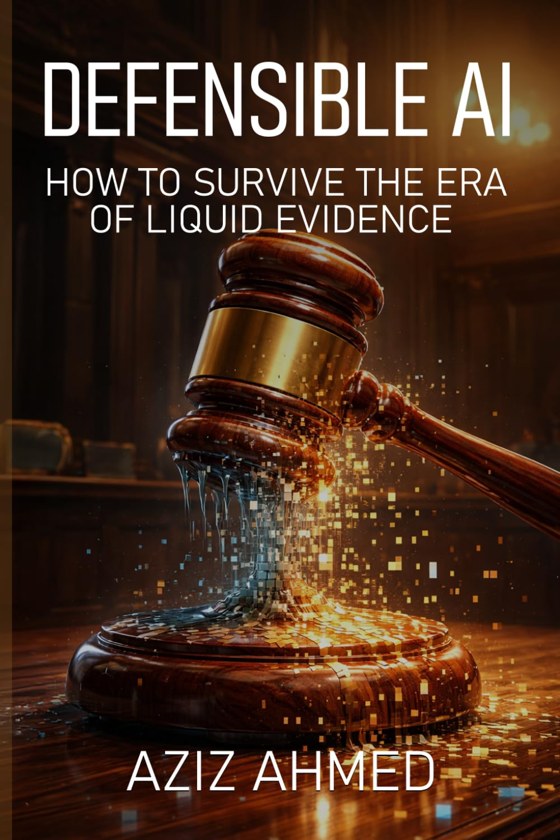
Defensible AI: How to Survive the Era of Liquid Evidence
Through real-world failures and hard-earned lessons, the book shows why accuracy alone is not enough, and how to engineer the four things every consequential AI decision needs: a Named Owner, an Evidence Loom, an Intelligent Loop, and a Liability Kill-Switch.

The author
Aziz Ahmed
Technology executive in regulated UK financial services and pensions, originator of the Liquid Evidence framework, and author of Defensible AI.
- 25+ years leading technology in regulated financial services and pensions
- Two filed US patent applications in AI governance and forensic auditability
- CMI Level 7 Diploma in Strategic Management and Leadership Practice